RxHCC, in plain language
Every Medicare Advantage drug plan gets a risk score for each member. That score reflects the member's diagnoses, demographics, and the risk model CMS updates each year.
More severe qualifying diagnoses can produce a higher RxHCC score — and the more CMS pays the plan to cover expected prescription costs.
CMS publishes the formulas every year. What it doesn't provide is an easy way to understand or use them. That's what this site is for.
Learn how Part D risk adjustment works →

The RxHCC Recommendation Engine
Find the RxHCCs already hiding in the record.
The engine reads the clinical record, identifies uncaptured RxHCC categories, and ranks them by impact.
Every recommendation comes with the evidence behind it. Prescribers review and confirm — keeping the clinician in control.
See how the recommendation engine works →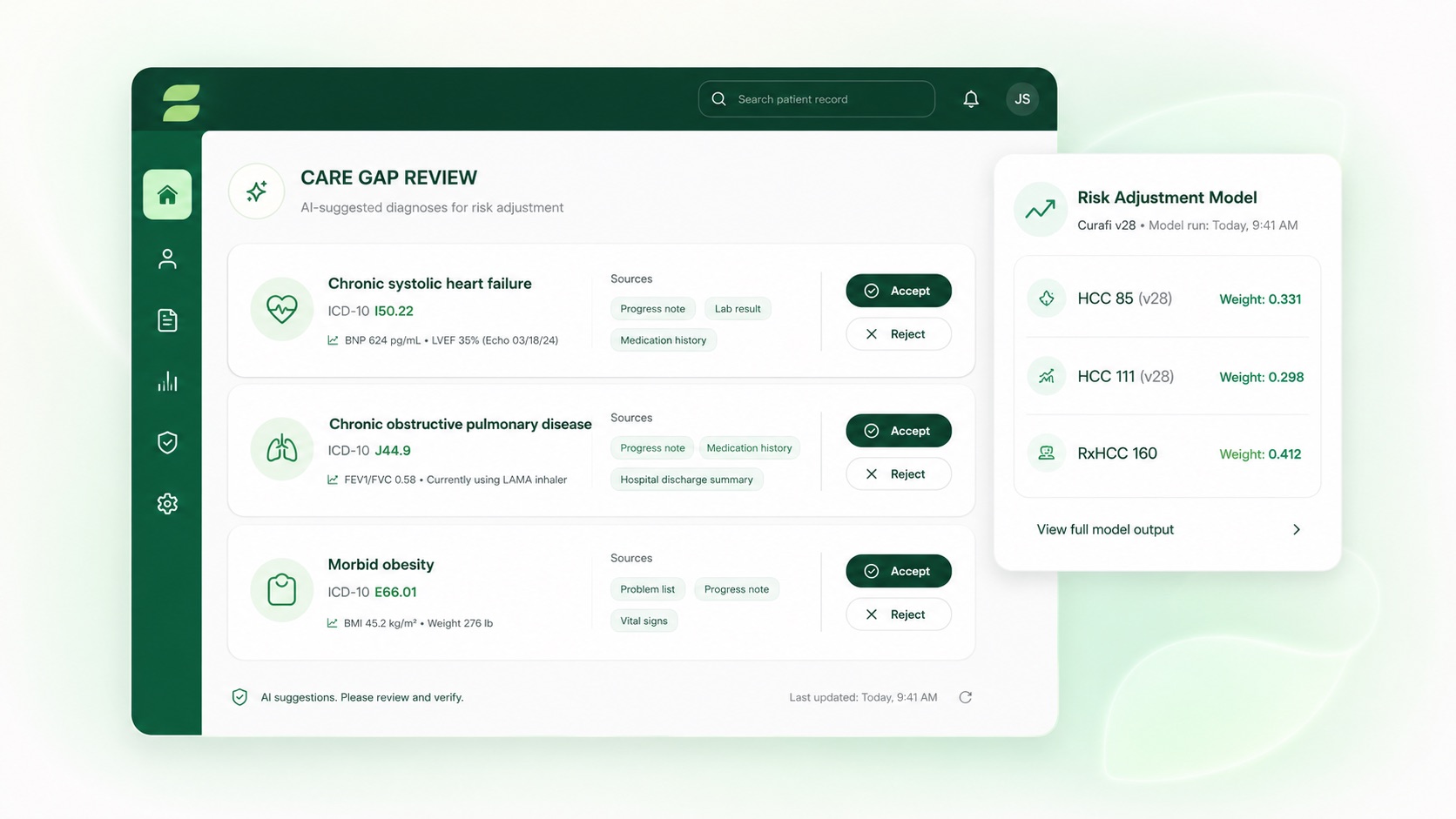

How plans capture RxHCCs compliantly
Plans work with providers to accurately document and code conditions already supported by the clinical record.
Every recommendation should be backed by evidence that can survive a RADV audit.
For most plans, a disproportionate share of pharmacy claims concentrates among a relatively small group of prescribers — making targeted provider workflows possible.
See the provider workflow →Documented, or it didn't happen
Increase scores without supporting evidence and CMS calls it upcoding. Document conditions already supported by the clinical record, and the score reflects the member's true risk.
Every legitimate RxHCC improvement should trace to clinical evidence in the patient record — with a complete audit trail ready for RADV review.
The safest path and the highest-value path are the same: document what the record supports.
Explore RxHCC audit readiness →
What makes this different

Open by default
Everything CMS publishes, translated into plain language and kept current. No login, no paywall, no sales gate on the reference layer.

Built for both sides
Plans and providers reading from the same page. Risk adjustment only works when the people coding and the people paid share an understanding.

Audit-ready by design
Every claim traces to clinical evidence. If it wouldn't survive a RADV audit, it doesn't belong in the submission.
The 2027 RxHCC model is final — separate segments for MA-PD and standalone PDP, refreshed coefficients, new methodology. Your 2026 baseline is already out of date.
From the library
The RxHCC Recommendation Engine
How point-of-care RxHCC recommendations work — evidence attached, RADV-ready.
MedPAC's V28 report, summarized
The latest MedPAC coding-intensity analysis — what year one of V28 actually showed.
MedPAC vs. CMS: whose number?
The Health Affairs reconciliation of the 4% and 1.5–2.0% estimates.
Retrospective vs. prospective RxHCC
Two operating models for the same compliant revenue engine — and when each wins.
IRA Part D redesign liability
The redesign moved real money onto plan balance sheets. The math, plainly.
PA turnaround under CMS-0057-F
72 hours, no exceptions. What the rule demands from your UM operation.
Questions, answered
Who is CuraFi?
The team behind this reference layer. CuraFi works with MA-PD plans, ACOs, and provider networks on compliant risk adjustment, utilization management, and prior authorization — and keeps this site free.
We align with your prescribers to document and code the acuity that already exists:
- Point-of-care recommendations with the evidence attached.
- RADV-ready by default — every code traceable to the record.
- Start with a population analysis — your data, twenty minutes, plain language.
What is RxHCC and why is it important?
RxHCC stands for Prescription Drug Hierarchical Condition Categories. It is the risk-adjustment model used by the Centers for Medicare & Medicaid Services (CMS) to predict and pay for prescription drug costs in Medicare Part D plans and Medicare Advantage Prescription Drug plans (MA-PDs). By mapping patient diagnoses and demographics to specific risk scores, it adjusts federal subsidies so that health plans caring for sicker, more costly patients receive fair funding.
The Inflation Reduction Act's massive Part D redesign shifted immense financial risk from the government to insurance plans, making precise RxHCC risk adjustment the single most critical lever for plan solvency and accurate funding.
How does the RxHCC model differ from the Part C CMS-HCC model?
- Part C (CMS-HCC): predicts medical and hospital spending (Parts A & B).
- Part D (RxHCC): predicts retail and specialty drug spending (Part D).
While both use ICD-10 medical claims data, they map to different condition hierarchies and assign different risk weights (coefficients) based on whether a condition primarily drives medical utilization or drug costs.
How can plans optimize RxHCC capture when primary care physicians focus mostly on Part C codes?
The vast majority of pharmacy claims are generated by a small cluster of top prescribers. Plans shouldn't try to retrain every provider on Part D coding. Instead:
- Target high-prescribing providers — the small subset driving most of your pharmacy claims.
- Surface actionable gaps — e.g., members taking high-cost medications on pharmacy claims who lack the corresponding documented diagnosis code in their medical chart.
- Close the loop at the point of care — get the treated condition documented and onto a claim.
Are RxHCC submissions subject to RADV (Risk Adjustment Data Validation) audits?
Yes. Medical record documentation supporting RxHCC diagnosis codes must meet the same MEAT standards as Part C codes to survive CMS RADV audits and avoid clawbacks:
- Monitor — the condition is followed over time.
- Evaluate — test results and status are reviewed.
- Assess — the clinician addresses it in the note.
- Treat — a medication, referral, or plan is attached.